




For decades, customer loyalty in retail has been driven by familiarity, trust and perceived value. Shoppers returned to brands they knew, often reinforced by points-based loyalty programmes designed to reward repeat spend and capture customer data.
But in 2026, loyalty looks very different. As outlined in the recent CX Network report, When Points Stop Working: The New Rules of Customer Loyalty, traditional loyalty mechanics are struggling to deliver meaningful engagement in an increasingly saturated and price-sensitive marketplace. Customers may be buying, but true loyalty, the kind that withstands friction, price increases or competitive pressure, is becoming harder to earn.
Loyalty at a crossroads
According to Peter Cross, former CX leader at John Lewis and Waitrose, today’s loyalty landscape can be summed up in three words: scarce, fragile and fleeting. While loyalty has always required strong products and service, economic uncertainty, the cost-of-living crisis and declining tolerance for poor experiences have made customers more transactional than ever.
Research cited in the report shows that although many shoppers say they ‘love and trust’ their favourite brands, the majority would still switch for a better price or leave after a single bad experience. In this environment, loyalty programmes have proliferated, but differentiation has not. As Cross notes, modern customers are inundated with points schemes, apps and so-called personalisation, yet often feel poorly recognised as individuals.
As a result, loyalty has shifted away from brands and towards value, convenience and influence. Younger consumers in particular are driven by authenticity, transparency and alignment with their values, rather than by accumulating points that feel interchangeable across retailers.
Why points alone no longer work
The report highlights a growing disconnect between how brands design loyalty programmes and how customers engage with them. Many retailers have invested heavily in loyalty infrastructure with the assumption that data collection will naturally lead to stronger relationships. Instead, participation and engagement remain low.
Dianna Lyngholm, Director of Creative Services at FUN.com, argues that the industry needs to move beyond ‘points for pounds’ models and reassess what customers actually value. In many cases, that means shifting towards exclusivity, subscription-style benefits or experiences that feel genuinely special, rather than incremental discounts that are easy to ignore.
This shift reflects a broader truth captured throughout the report: transactional incentives may drive short-term behaviour, but they rarely build emotional commitment.
Building loyalty beyond the transaction
So what does effective loyalty look like in today’s retail landscape? The report makes clear that sustainable loyalty is rooted in emotional connection, consistency and trust.
Ebrahim Hyder, a VP of Customer Care, emphasises that customers return to brands that make them feel understood, appreciated and inspired. This emotional resonance is reinforced through product quality, storytelling and service, particularly in moments of friction such as returns, repairs or delivery delays.
Crucially, loyalty is now built across the entire end-to-end journey. Customers expect a seamless experience across channels, whether they are browsing online, visiting a store or engaging with remote service teams. Consistency in tone, service and brand values is no longer optional; it is foundational to loyalty.
Creating belonging, not just reward
The strongest loyalty strategies also focus on creating a sense of belonging. Community-led models from brands such as Harley-Davidson, Nike and Patagonia demonstrate how shared identity, values and access can turn customers into advocates.
As explored in the report, loyalty programmes that offer exclusive experiences, personalised moments or alignment around shared values invite customers to become participants in a brand’s world, not just repeat purchasers. In many cases, this sense of inclusion is more powerful than any discount.
Loyalty in the age of AI
Looking ahead, the report warns that advances in AI-driven search and discovery will further disrupt how loyalty is formed. As customers increasingly rely on conversational platforms and AI assistants to navigate choices, trust and preference may shift away from brands altogether.
To remain relevant, retailers must focus on effort reduction, clarity and continuous value, ensuring loyalty is earned in moments where customers feel genuinely guided and understood.
Continue the conversation
As the CX Retail Exchange UK returns on 1-2 July 2026 at Hilton Syon Park, London, loyalty will be a key topic on the agenda, alongside unlocking value through AI & Data, organisational capability for Omnichannel excellence, and leveraging data to drive personalisation.
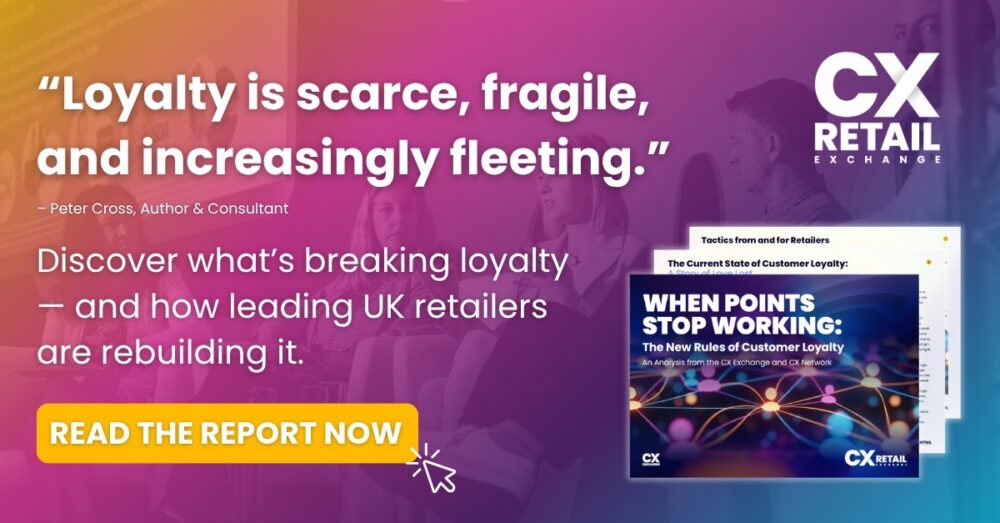
To explore the findings in more detail, download the full CX Retail Loyalty report. And to continue the conversation with senior retail and eCommerce leaders facing the same challenges, request your complimentary invite* to the CX Retail Exchange UK.
*Subject to seniority and suitability
The post When Points Stop Working: The New Rules of Retail Loyalty appeared first on 365 Retail – Retail News and Events.