



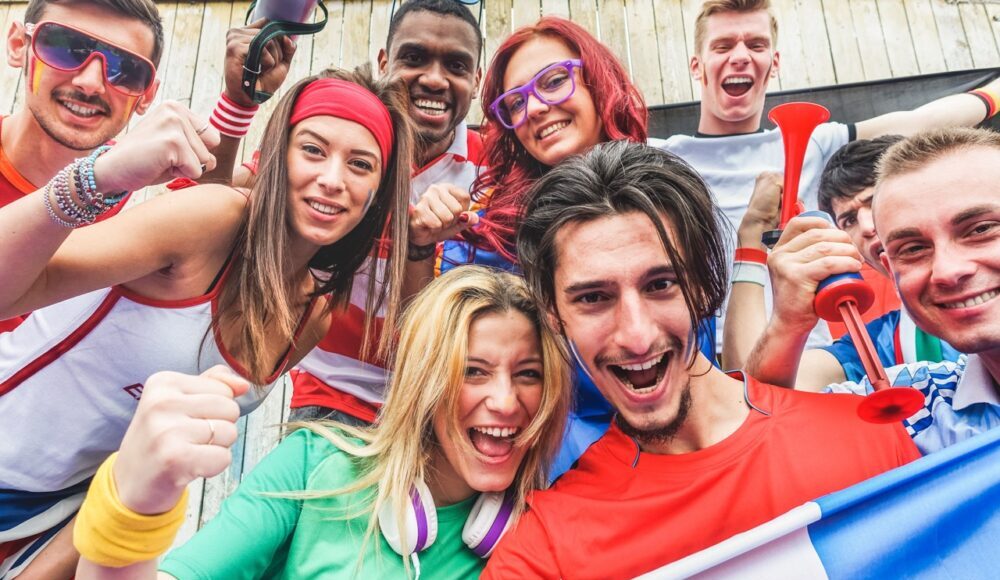

If my experience of living in London during the 2012 Olympics is anything to go by, then this summer will be a special one, as I’ll get to be present and on-the-ground in the US for the FIFA World Cup 2026. Not because of the matches or ceremonies alone, but because the entire North American continent will take on a different emotional rhythm.
Major sporting events are emotional peaks for fans. The culture and shared experience around the event matters just as much as the event itself. Brands can learn from this. If a Venn diagram were to exist, with retail experiences on the left and the major sporting events on the right, emotion would sit at the intersection. The brands that win their own die hard fans won’t be the loudest, they will be the ones that design experiences around the emotional journey of fandom.
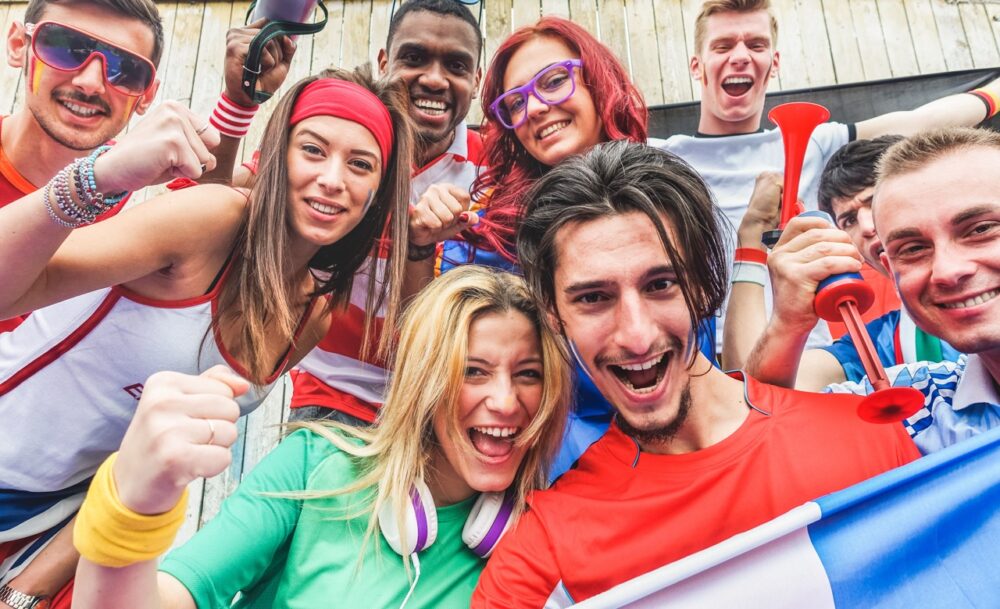

Cultural alignment with sporting events means watching the moment unfold together, emotional connection is how to become an integral part of a fan’s story and moment – moving the consumer from consideration to preference to build loyalty, drive engagement and longer-term relationships. A report into the world of fandom found that 84% actually wanted more engaging experiences from brands, reporting that it would enhance their perception and preference for that brand.
For the Women’s 2023 FIFA World Cup in Sydney, we created a Dream Arena, a 3-month retail pop-up for Nike grounded in first-hand consumer insight from interviews with consumers, female football fans and professional footballers, to ensure the concept and experiences truly resonated.
The result was a space that emotionally ignited the spirit of women’s football – facilitated through a smart programming of event experiences and engaging digital interactions – and delivered commercial results 36% above the original forecast.
Projects like this push us to think more broadly about the role brands can play in moments like these. When you start mapping emotional journeys, you begin to see fandom as a significant creative opportunity for your experiences.
With the World Cup fast approaching, it’s the right moment to look at how brands are beginning to design around that emotional arc, across everything from experiential marketing to retail environments and activations. Here is a breakdown of the kinds of experiences starting to emerge.
Pre-match rituals
In the build-up, fans experience fluctuating levels of excitement, nerves and anticipation, and these emotions are often channelled into familiar pre-match rituals.
The importance of rituals for fans in sport are significant, with a study by the Proceedings of National Academy of Sciences (PNAS) showing that the intense feelings surrounding sports can be “less about the game and more about the ritual of coming together.” Using heart monitors to study the emotional reactions of fans, PNAS found that the levels of shared excitement called “collective effervescence” showed a peak during the pre-game rituals specifically.
When brands authentically integrate themselves into those pre-match rituals, they tap into that sense of anticipation at its most emotionally charged – building stronger, more memorable connections before the game even begins.
For example, Heineken’s Publivery pop-up experience in Lisbon – where the brand enabled two Arsenal football fans to continue their pre-match ritual when their team reached the Women’s Champions League Final. The Twelve Pins in Finsbury Park is the match-day home for fans Amelie Margaret Kirk and Sophie Hurst. As part of Heineken’s goal to celebrate football’s most hardcore fans, it created a pop-up version 2,200km away in Lisbon to ensure these superstitious fans had a “travelling talisman” for the big occasion.
Match-day: A sense of belonging / community
Sport has always been about more than the result. It’s about identity, ritual, and belonging – the feeling of being part of something bigger than yourself. Fans become communities that are bound by shared passions, shared language, and shared emotional highs and lows.
“A feeling of belonging to a tribe or a country, or even a community, not only gives us a sense of acceptance, but it can also enhance social cohesion.” British Psychological Society.
In a world that feels increasingly fragmented, these moments of collective experience matter more than ever. Sport remains one of the few places where people still come together and feel part of something bigger. Brands have a real opportunity to protect, support, and amplify that sense of belonging.
The Lacoste 5th Ave flagship is one of my favourite recent store openings in New York, with its impactful heritage storytelling and strong links back to tennis. The store served as a central hub to the brand’s activation of New York for the US Open last year – with key experiences around the city like a tennis-themed afternoon tea at The Plaza and tennis clinics in Central Park with a visit from Lacoste’s star athletes including Novak Djokovic – both creating shared experiences for tennis fans to come together around.
Finally in the beautiful Printemps store, Lacoste hosted a take-over of their pop-up space to offer exclusive product customisation throughout the duration of the tournament. All-in-all, a connected campaign anchored by their flagship to bring the tennis community together during their biggest moment of the year in NYC.
Post-match recovery
The final whistle isn’t the end of the emotional journey. Whether it’s the euphoria of a win or the heaviness of a loss, the hours after a match are when that passion is at its most raw and unresolved. Researchers from the University of Sussex found that the pain football fans feel after a defeat “is more than double the joy of winning.”
This creates a powerful and often overlooked opportunity. Not to extend the hype, but to provide comfort and decompression – helping fans regulate, reflect, and reset. When done well, it builds trust, warmth, and long-term emotional affinity.
The Oakley Exoplanetary bunker in Paris, set in a brutalist-inspired safe house, is a place for both Team Oakley athletes and guests to unwind, refuel, and reset between competitions. A large auditorium and themed rooms offered food, live game viewing, and hang out spots, with an ambient DJ setting the mood throughout the day. Beyond that, the space includes an athlete-only area and a series of rooms, each designed to bring a different part of the Oakley story to life.
These rooms included a dedicated recovery experience with massage chairs and guided meditations, a museum showing iconic products, the custom cutting of glasses lenses and an innovation zone.
Major sporting events represent some of the most emotionally charged moments in culture, and that makes them some of the most powerful commercial opportunities too – if tackled in the right way.
In moments like the World Cup, fans don’t need more noise. They need places that understand what it feels like to care this much. The brands that get that right won’t just be seen – they’ll be felt.
The post The Feeling of Fandom: How Emotional Journeys Shape Brand Experiences appeared first on 365 Retail – Retail News and Events.